Observe. Integrate. Design
Permaculture
Design Course
Temperate permaculture design
with Trent Rhode.

25Learning modules
10Design Exercises
1Continuing design project

Learning from living systems
It’s the connections
that matter!
Observation is the beginning of design.
There are underlying guiding principles at work in ecological systems (ecosystems) that can be observed and integrated into one’s own understanding and being, as many indigenous and Earth-connected peoples have shown through history (and continue to demonstrate).
These principles are not found in the linear, isolated, fragmented logic that is apparent in most existing human culture and its economic systems, but in a more holistic logic that sees all things as connected and interdependent. This way of seeing does not reject the power of reason and reductionism—or breaking things down into their constituent parts to examine them closely. However, it necessitates simultaneously and primarily seeing ecosystems holistically. That is, seeing the components of an ecosystem as they relate to the whole of which they are a part and the way each element forms beneficial connections with other elements of the system. For ecosystem health and resiliency, it’s not the diversity alone that’s important, it’s the number of beneficial connections between the different living and non-living parts of the ecosystem that are most important. It’s the connections that matter!
For this program, the key principle of design that informs all others is the principle of protracted observation: the idea that when we observe something deeply, thoughtfully, and with our full attention, it changes not only our understanding of how we can interact with it in a positive, life conducive way, but also changes us at a fundamental level, shaping how we then perceive the world and interact with it—helping us understand that we are part of the environment healing itself, rather than a foreign entity imposing its will upon the land.

Begin the course
Start with Introduction to Permaculture and develop one design project as you move through the course.
Your field guide
How to use
this course
This course is organized into 25 modules and ten Design Exercises. The modules cover PINA core topics 1–25. Any certificate or instructor-assessed pathway is arranged separately.
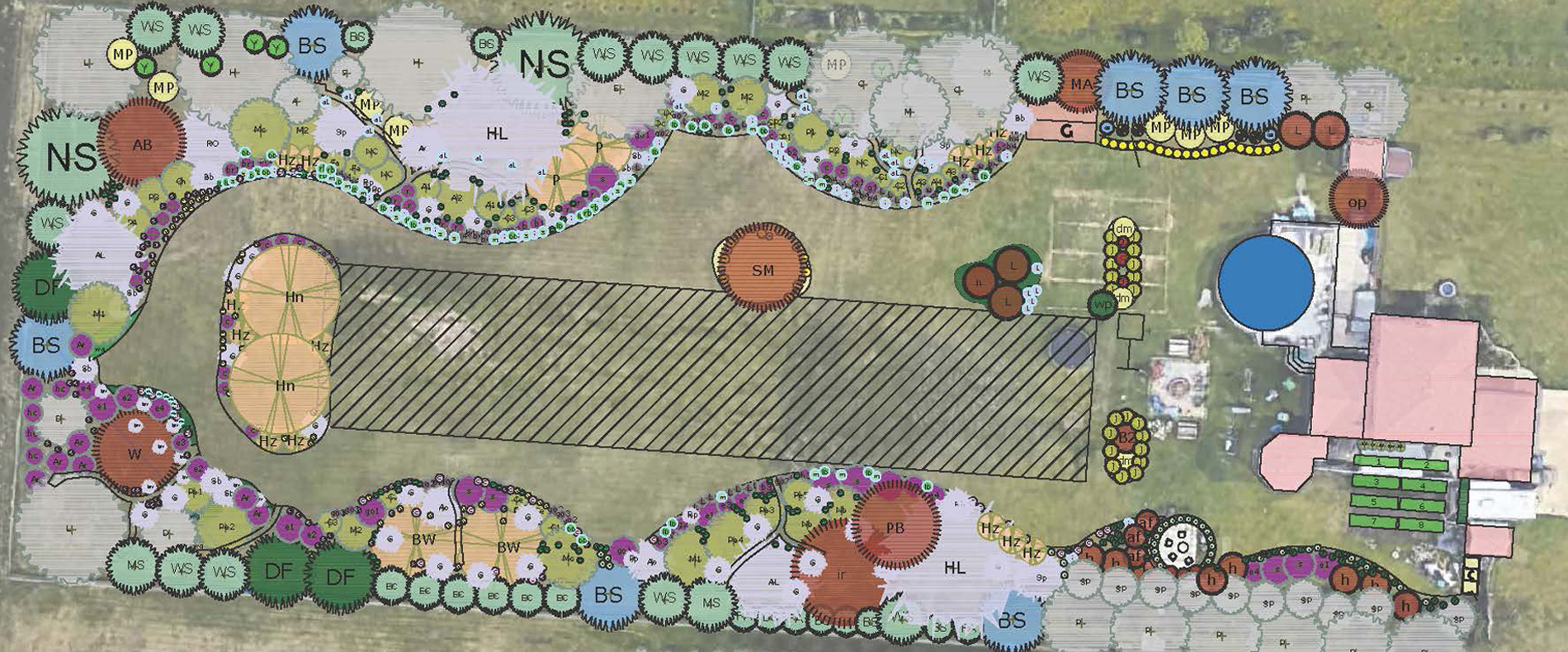
Work through one continuing design project. Maps, plant choices, budget notes, discussions, and the final presentation belong to that same project. The four optional three-question checks are for practice, not additional submissions.
Use each module’s study guide to identify the core readings and videos. Some modules also list supporting resources for deeper study. Read a shared selection once, then return to it when applying the material. Optional resources do not create extra assignments.
When an activity asks you to share or discuss your work, email the files listed in that activity to the address under “Get In Touch” on the Living Landscapes Design contact page. Do not use the contact form. Include the Permaculture Design Course, module number, and activity in your subject or message. Save written notes as a document or PDF; use clear photos or scans for paper work, and attach spreadsheets or presentation files where the activity calls for them. Related work can be combined in one file.
These discussion prompts are opportunities for instructor feedback unless the activity specifically says a submission is required.
About permaculture and this course
What is Permaculture?
"The only ethical decision is to take responsibility for our own existence and that of our children." - Bill Mollison, cofounder of Permaculture Design system
Permaculture in its simplest definition means “permanent culture”: a culture that is not only sustainable, but also regenerative (repairs existing ecosystem damage), since at this point in time, it is no longer enough just to sustain our existing systems.
The roots of permaculture design lie in indigenous land-use systems dating back untold thousands of years, some of which are still being practiced in an unbroken lineage to the modern-day (though increasingly rare, unfortunately).
Permaculture encompasses and builds on a set of ecological principle-based approaches for consciously and creatively designing regenerative systems that meet human and ecosystem needs. At the heart of the modern permaculture movement is the understanding that we must redesign and repair our life support systems (economic, social/cultural and ecological) to be life-conducive rather than life-destructive.
Although modern permaculture began as a system for integrating home scale agriculture with one’s immediate surroundings on a homestead level, it has evolved into a design system that can be used to design all aspects of human activity, from small and large scale agriculture, to architecture, learning environments, community design, and even economic and social systems.
Permaculture and this Program
The permaculture design community has brought together many useful tools and perspectives from many disciplines and traditions into a fairly unified, extremely useful package, but it can be counterproductive to consider permaculture design a static practice or specific ideology. This can and has led to dogmatic thinking even in the permaculture community.
Rather than thinking of this course as a way to be initiated into some specific way of seeing the world, or a specific type of design process, then, I invite you to think of it as a way to explore some toolboxes and lenses from different disciplines of human endeavour and perspectives, including from indigenous land-use systems, ecology and ecological restoration, biology, agroforestry, organic agriculture, keyline design, and landscape design, all with the aim of learning how to create regenerative habitats that fulfill human and non-human needs.
The below learning modules cover topics 1–25 in the Permaculture Institute of North America’s (PINA) core curriculum, which in turn has evolved from the original Permaculture Institute’s required curriculum.
The core modules cover basic ecological theory as applied to garden and farm design, design methodologies, needs analysis, zones and sectors, and other basic natural design approaches. We also cover pattern analysis and the observation, mimicking, and pattern adaptation from natural systems and cycles.
Many PDCs are done over a period of 10-14 days. Other formats include over a few weekends, or entire year-long programs done partially remotely with stints on site. If you are taking this course as part of a certificate pathway, the applicable attendance, instructor-contact, and design-project requirements will be explained separately. You can get in touch with me any time to ask questions or discuss things through the Living Landscapes Design contact page.
This curriculum will be covered through exercises, media, and projects. Use the study guides to connect readings, videos, discussions, and field observations to your design project.
Learning Goals for Participants: Participants complete the course with a basic understanding of:
- Permaculture ethics and principles, including sample strategies and techniques for realizing them in design
- Reading landscapes, interpreting all elements and their relationships to each other
- Applying permaculture principles to land and community development in small- and large- scale designs
- Methods and tools for adopting these practices in all aspects of their lives
Work at a pace that permits observation, study, and practical follow-up. Seasonal activities may continue beyond the reading period.
Any media named without a public link will be provided through the course or can be requested through the Living Landscapes Design contact page. Videos with a link play from their original source; if a video player does not load, use the linked source page instead.

The learning journey
Course modules
Explore the modules in order, then bring your work together in the Design Exercises.
- 01
- 02
- 03
- 04
- 05
- 06
- 07
- 08
- 09
- 10
- 11
- 12
- 13
- 14
- 15
- 16
- 17
- 18
- 19
- 20
- 21
- 22
- 23
- 24
- 25
The course bookshelf
Books & reading access
The exact pages or chapters for each module are listed where the reading is assigned. Use your own copy, buy the book, or borrow it through a library when possible. If you are local to me, contact me about borrowing a copy. You can also use the Living Landscapes Design contact page for information about digital or other access to the assigned readings. If your edition uses different page numbers, contact me and we can match the correct section. Articles, excerpts, videos, and online tools are listed in the module where they are used, with direct links where a public student link is available.
Ask about assigned readings ↗Using the readings
EFG 1 and EFG 2 mean Edible Forest Gardens, Volumes 1 and 2. Page references follow the editions assigned by the instructor.
RFH means The Resilient Farm and Homestead. Practical Permaculture and The Permaculture Earthworks Handbook use the assigned edition page references.
Restoration Agriculture and The Permaculture City are reflowable EPUBs, so use the chapter title and named subsection. Mollison readings use the assigned edition. If any page number does not line up in your edition, contact the instructor and we will match the correct section.
Use your own copy, buy the book, or borrow it through a library when possible. If you are local to me, contact me about borrowing a copy. You can also contact me for information about digital or other access to assigned readings.
The main readings for the program are in the books The Resilient Farm and Homestead by Ben Falk, Edible Forest Gardens, volumes 1 and 2 by Dave Jacke and Eric Toensmeier, Permaculture Designer’s Manual by Bill Mollison, and Restoration Agriculture by Mark Shepard (optional, but good if you are interested in exploring large scale farming more). I have digital copies and recommend some of these if it’s in your budget. The readings are only excerpts from the books, not the full books.
I particularly recommend owning Edible Forest Gardens, volumes 1 and 2 and The Resilient Farm and Homestead. Restoration Agriculture is especially worth considering if you are interested in larger-scale farming.
The Resilient Farm and Homestead
Ben Falk
Edible Forest Gardens, Volume 1
Dave Jacke and Eric Toensmeier
Edible Forest Gardens, Volume 2
Dave Jacke and Eric Toensmeier
Permaculture: A Designer’s Manual
Bill Mollison
Practical Permaculture
Jessi Bloom and Dave Boehnlein
The Permaculture Earthworks Handbook
Douglas Barnes
The Permaculture City
Toby Hemenway
Restoration Agriculture
Mark Shepard (optional for students interested in larger-scale farming)